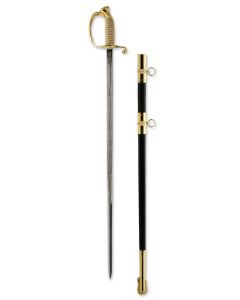
How
to Size a Military Sword or Saber We
periodically receive questions about how to properly size a sword or saber.
Contrary to much of the information that is out there, the
sword and saber blade length is not simply a function of a persons
height.
The correct
length is the blade length that will place the tip of the blade at approximately
eye height when an individual carries the sword at the Carry Sword
position (sword drawn, arm at side, and blade in a vertical position pointing
up). More correctly then, the correct blade length is a function of the
individuals arm length, the individuals neck length, how the
individual carries the sword piece, and even the type of sword. Why
is blade length important? For those
intending to mount the sword or saber on a wall and having no intention
of executing manual of arms (draw sword, present arms, parade rest, etc.),
blade length is not critical. A 30-inch blade length is the most common
length, generally fitting those between 58 and 511
in height. For those
intending to execute manual of arms, blade length is important. A sword
blade that is too long not only looks odd and non-uniform, but also risks
knocking off headgear or increases head movement when going to the Carry
Sword position. What
sword or saber length do I need?
- The best way to
size a sword or saber is to hold another sword or saber in the Carry
Sword position to see how the length fits.
- If one does not
have another sword or saber on hand, measuring for the fit is possible.
Stand at a modified position of attention with your arm extended down
at your side and your fingers extended down.
- Measure from your
eye to the V between your thumb and your index finger.
Using this measurement, the correct sword length depends on the type
of piece:
- If you are within a 1/2-inch of a sword size: we generally recommend rounding up to the nearest size.
- If you are within 1-inch of a sword size: we generally recommend rounding down to the nearest size.
- For 1-1/2-inches: since most of our swords are sized in 1" increments (a few are offered in 2" size increments) it would be rare to have a 1-1/2-inch rounding issue, unless we were back-ordered on some sizes and you needed a sword very quickly. We would generally suggest against rounding 1-1/2-inches or more, but if necessary, we would suggest rounding down to the nearest size. It is easier to compensate for a shorter length sword by slightly raising your hand/arm's position (to bring the point up to eye level) than it is to compensate for a longer sword by lowering your hand.
|